
Social media content production is the work between a content plan and a published post: briefing, shooting or generating, editing, approving, resizing and scheduling. For a brand, the hard part is not ideas. It is producing enough on-brand photos and videos, week after week, without booking models, sets and reshoots every time. That is the problem our studio solves: we make social media content, product photography, model shoots and UGC-style ads with generative AI, so a monthly content set does not depend on a physical shoot.
This guide covers the production routine a brand marketer or e-commerce owner needs: what to decide first, which formats earn their cost, how to run a repeatable pipeline and what to check before AI-made visuals go live.
TL;DR
- Decide goals, audience and platforms before formats. Production cost is wasted when the plan is vague.
- Short vertical video, product photos, carousels and UGC-style clips are the core formats. Match the polish to the stakes of each post.
- A repeatable pipeline (brief, produce, approve, adapt, publish, measure) beats one-off shoots.
- AI production removes the shoot logistics, but every frame still needs a human check against the real product, and some content needs disclosure.
- Our studio delivers monthly social content, with look frames approved by you before production starts.
Table of Contents
- Start with the plan, not the camera
- Which formats are worth producing
- The mix of content: what the "rules" mean
- A repeatable production pipeline
- Why a traditional shoot slows social content down
- What to check before AI-made content goes live
- How to measure whether the content works
- Where our studio fits
- FAQ
- Sources
Start with the plan, not the camera
Production is the expensive step, so it should be the last one you decide. A practical order, which Sprinklr's strategy guide also recommends, is goals first, then audiences, then platforms, then formats and calendar entries. Each choice follows from the one before it.
In practice that means:
- Goals tied to the business. Buffer suggests measurable, time-bound goals, such as raising engagement rate by 20% in a month, rather than "grow our presence."
- Audience habits. Where do your buyers spend time, and what do they expect from a brand there?
- Fewer platforms, done well. Cision notes that spreading effort across too many channels dilutes impact and consistency.
- One brand voice, adapted per platform. The visuals should look like the same brand on every feed.
If you want a second view on turning audience insight and goals into content pillars, this social media content creation service guide walks through what to expect from a content service and how to choose one.
Once you have the plan, write it down as a one-page brief for each batch of content: goal, audience, core message, call to action, brand constraints and placements. A six-stage visual content workflow starts the same way, then moves to mood boards or shot lists, production, editing and approval, platform formatting and measurement.
Which formats are worth producing
Not every format earns its production cost. The evidence points to a short list.
Short vertical video
HubSpot's 2026 content data reports short-form video as the top priority for social marketers, with 21% naming it the highest-ROI format. Its guidance is vertical 9:16 video under 60 seconds, captions or on-screen text, and a strong hook in the first three seconds. Sprout Social reports that users rate short-form video as the brand content they are most likely to engage with, with preferred length shifting under 60 seconds.
Product photos and carousels
Product photography anchors the brand visually and feeds product pages, ads and posts from one set of assets. Carousels carry more detail per post: an analysis of millions of Instagram posts cited by Buffer found video earned more reach while carousels earned more engagement. For beauty, Branditify's 2026 guide says short video suits application and texture, while photography stays valuable for shade accuracy, packaging and ingredient labels.
UGC-style content
HubSpot's data also reports that 90% of shoppers say user-generated content influences their purchases more than search results or promotional emails. That is why brands want UGC-style clips: people talking to the camera about a product, in a casual format that feels native to the feed. Our studio produces AI UGC ads for brands that need this look without recruiting and shipping product to creators.
Match polish to the stakes
A hero film for a launch and a Tuesday product teaser do not need the same production. Plan a mix: a few polished, high-trust assets, a steady layer of fast mid-tier content, and low-effort native clips for testing. If you want the ad side of this mix, see our guide to social media ad creatives.
The mix of content: what the "rules" mean
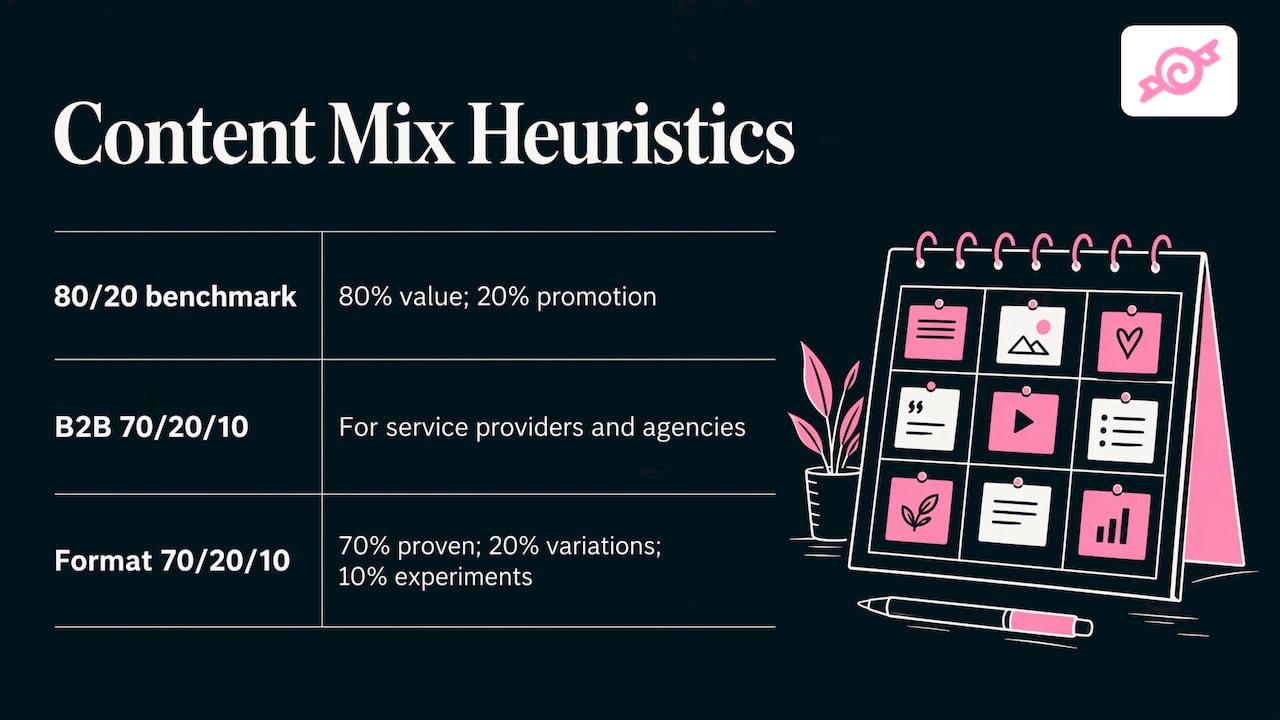
Searchers often ask about the 70/20/10 or 80/20 rules. They are planning heuristics, not laws, and different publishers define them differently. Metricool calls 80/20 (80% value-driven content, 20% direct promotion) the most reliable promotional benchmark, and says a 70/20/10 split suits B2B service providers and agencies. Another version, described by Clipflow, puts 70% on proven formats, 20% on variations and 10% on new experiments.
For production, the useful reading is the experiment share: reserve a slice of each month's output for new visual ideas, and let the results decide what gets repeated.
A repeatable production pipeline
A pipeline turns content from a scramble into a routine. This is the sequence that works for a small marketing team.
- Brief. One page per batch: goal, audience, message, CTA, brand rules, placements. The more precise it is, the fewer revisions later.
- Concepts. Write three to five concepts per week or per month, using the words customers use in reviews and support questions.
- Look approval. Agree on the visual direction before anything is produced. With traditional shoots this means mood boards; with our studio, you approve look frames before production starts, so you see the direction first and pay for it only once.
- Produce a master set. Make a small number of carefully built hero assets: a product video, a model image set, a few stills.
- Adapt. Cut the masters into the lengths and ratios each platform needs: vertical clips, square and 4:5 stills, carousels.
- Review. A person checks every asset for accuracy, brand fit and claims.
- Schedule and publish. Consistency matters more than bursts. Shopify's guide notes that posting twice a week for eight weeks beats 16 posts in one day.
- Measure and repeat. Hootsuite ties metrics to goals: reach and impressions for awareness, comments, shares and saves for community.
Batching and repurposing
Buffer's guide describes batching as planning, scripting, filming and editing ahead of time, with about a week of content in advance as a balance between preparation and relevance. It also recommends repurposing blogs, webinars and research into clips, carousels and graphics instead of starting from nothing. The same logic applies to visuals: one product asset set should become dozens of posts.
If your team is weighing which parts of this to automate, our piece on social media content automation separates what to automate from what to produce.
Why a traditional shoot slows social content down
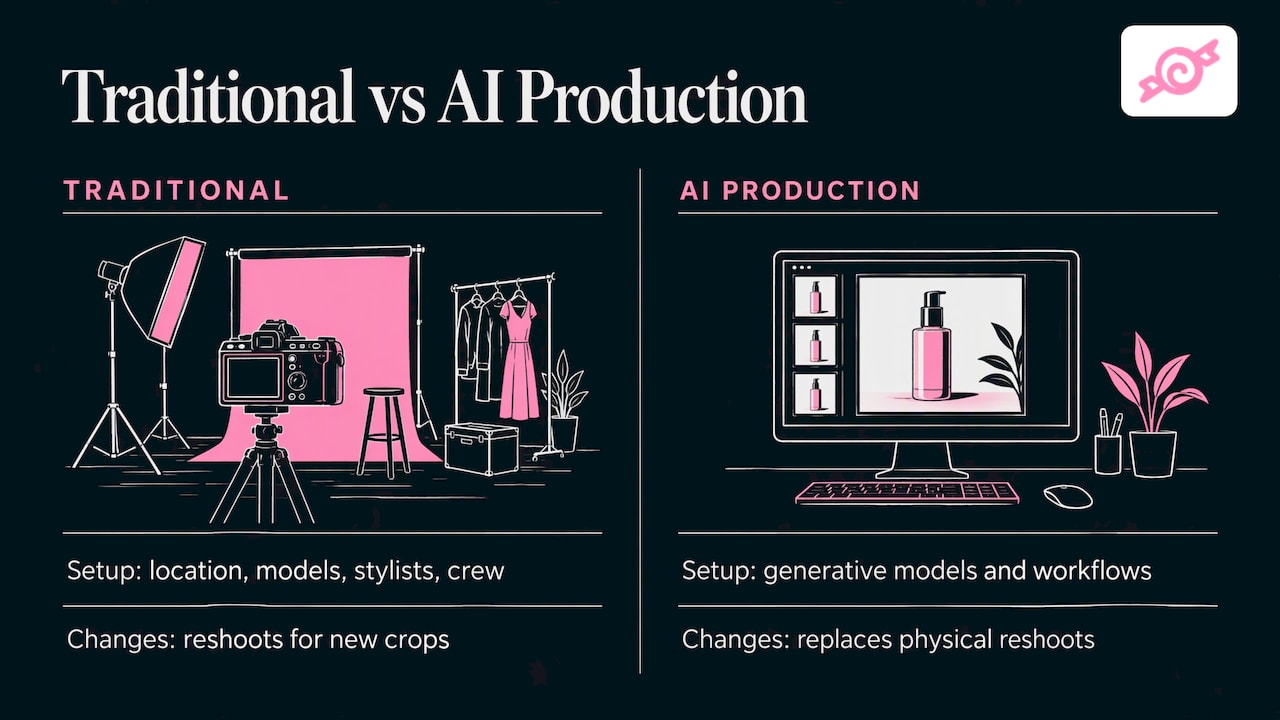
A conventional shoot for social media needs a location or studio, models, stylists, props, a crew and a date everyone can make. Then reshoots arrive when a colorway changes, a caption needs a different crop, or a campaign needs a new angle. For a brand posting several times a week, that cycle is the bottleneck.
AI production changes the constraint. Our studio replaces physical models, sets and reshoots with generative AI models and workflows, which is why we can typically turn around product photography within 24 hours. We customize our models for each industry and check every frame by hand, so the output stays accurate to your product and your brief. Fashion, beauty, footwear, bags, electronics, home decor and food each have different visual demands; you can see how we handle them on our industries page.
The same assets can serve more than social: product listings, ads and brand storytelling all draw on the same library. Our guides to product video production and AI commercial production show how one set of visuals stretches across formats.
What to check before AI-made content goes live
AI speeds up production, but the brand is still the publisher. Four checks keep it safe.
1. Compare every asset with the real product
Check color, shape, labels and packaging against the physical item. AKOOL's workflow guide recommends exactly this, plus human review of claims, pricing and legal copy. Beauty brands should be especially careful: Branditify advises avoiding filters or grading that change a product's shade, and keeping color-accurate files separate from styled campaign images.
2. Keep a human reviewer in the loop
Hootsuite's 2026 guidance treats AI as a drafting and workflow aid, with human review for accuracy, brand fit and perspective before publication. Our process follows the same principle: every frame is checked by hand before delivery, and you approve the look first.
3. Think about disclosure
The International Chamber of Commerce's 2026 guidance says using AI does not automatically require disclosure, but disclosure may be needed to prevent a misleading impression, and that a disclosure does not fix a false claim. The IAB's January 2026 framework calls for disclosure when AI materially shapes content in a way that could mislead a reasonable consumer about authenticity, identity or representation. It is guidance, not law, and platform labeling rules may differ, so check the labeling settings on each channel you post to.
4. Keep reviews and testimonials real
An AI-made UGC-style ad is a brand-made ad. Do not present it as a genuine customer review. In the US, the FTC's final rule on fake reviews and testimonials addresses testimonials that misrepresent who wrote them, including AI-generated fake reviews, and lets the agency seek civil penalties against knowing violators. Frame UGC-style content as brand creative, and keep actual customer reviews as actual customer reviews. For advertising questions specific to your product claims, ask your attorney.
How to measure whether the content works
Benchmarks vary by industry and platform, so compare your own content over time. Branditify suggests tracking saves and shares, audience questions, product-page click-throughs and recurring themes in support or review messages. For paid creative, test each new concept for a few days and look at hook rate, hold rate and click-through before scaling the winners.
Then feed the results back into the brief. If vertical product demos consistently outperform static stills, the next batch shifts toward them. Because AI production has no set to rebuild, changing direction is a new brief, not a new shoot.
Where our studio fits
BlurCandy Studio produces social media content, AI UGC ads, AI model photoshoots, product photography, CGI and 3D product films, and ad films and commercials for brands across industries. We work project by project, with custom quotes based on scope and deliverables, and more than 200 brands have worked with us, with a 4.8/5 client rating.
For a brand that needs a steady stream of visuals, the practical benefit is that the whole content set is built without a physical shoot, with look frames approved before production. You can see the range of our output in our portfolio and the full list of what we make on our services page.

If you already have a brief or a product catalog, send it to us through blurcandy.com and we will scope a content package around it.
FAQ
How do I start producing social media content for my brand?
Write down your goal, audience and one or two platforms, then build a one-page brief for your first batch. Produce a small set of hero assets and adapt them into several formats. Post on a steady schedule and review results every week or month.
How much social media content should a brand produce?
Consistency matters more than volume. Shopify's guidance favors a regular cadence, such as twice a week, over bursts of posts. Start with a rhythm your pipeline can sustain, then add channels and frequency as results justify it.
Which social media formats are best for product brands?
Short vertical video under 60 seconds, product photos and carousels form the core. UGC-style clips add social proof in a native format. Choose by platform and goal, and reserve a small share of output for testing new ideas.
Can AI-generated visuals be used for social media posts?
Yes, as long as the content is accurate to the real product, reviewed by a person and not presented in a misleading way. Check platform labeling settings, and consider disclosure where AI could mislead viewers about authenticity or identity.
Sources
- Sprinklr: Social Media Content Strategy
- Buffer: The Ultimate Guide to Social Media Content Creation
- Buffer: Become a Social Media Creator
- Cision: How to Create a Social Media Marketing Plan
- Postplanify: Visual Content Creation workflow
- HubSpot: The most effective types of content on social media
- Sprout Social: Popular Types of Social Media Content
- Branditify: Social Media Strategy for Beauty Brands
- Metricool: Promotional Content on Social Media
- Clipflow: The 70/20/10 Rule for Content Innovation
- Shopify: How To Create Content for Social Media
- Hootsuite: AI social media content creation workflow
- AKOOL: Turn One Product Shoot into a Month of Social Content
- ICC: Guidance on AI and Marketing Communications
- IAB: AI Transparency and Disclosure Framework
- FTC: Final Rule Banning Fake Reviews and Testimonials