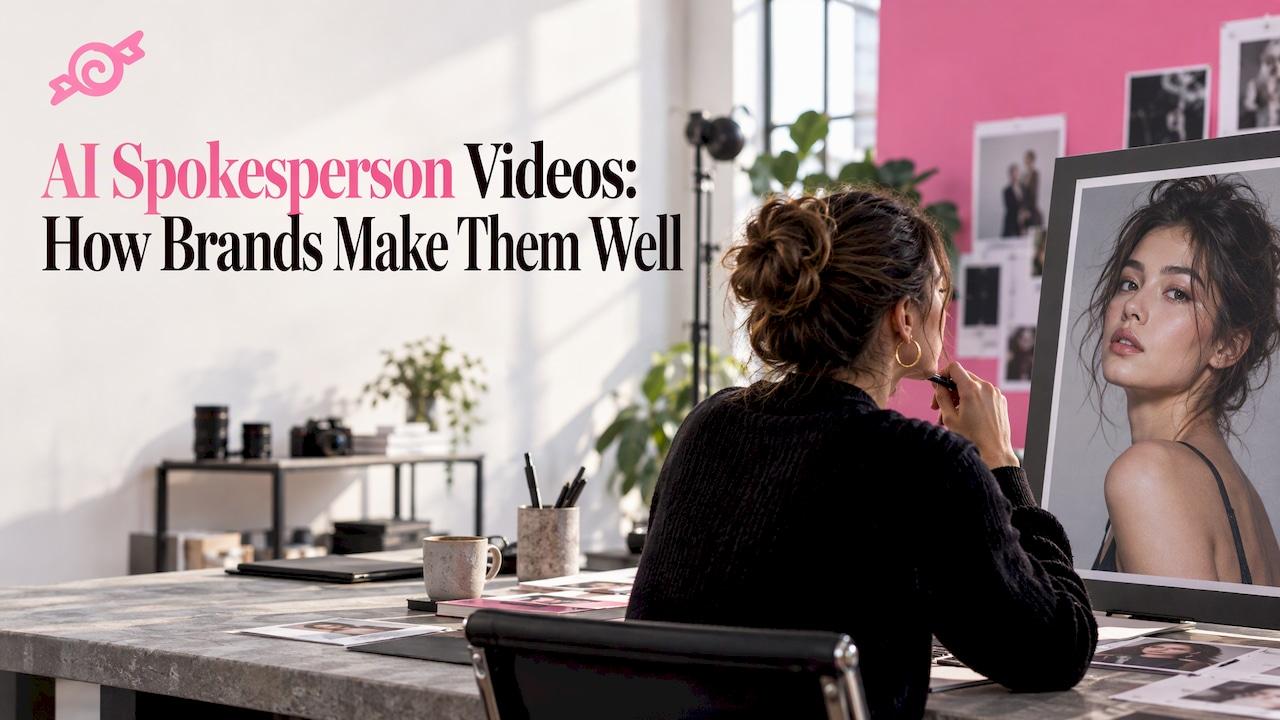
An AI spokesperson video is a presenter-led video in which a synthetic person delivers your script on screen, with no camera crew, studio or booked talent. Done well, it gives a brand one consistent face for ads, product pages and social content, and new versions in a day rather than weeks. The quality depends less on the software than on the brief, the approved look and a frame-by-frame review. That is how we work at BlurCandy: we produce AI ad films, AI UGC ads and AI model photoshoots for brands, and clients approve look frames before production starts.
This guide is for marketers, e-commerce owners and brand teams who want to commission or plan this kind of content. It covers what the format is, how a script becomes a finished video, how AI models work for product photography and model replacement, and the legal checks to run before anything goes live.
TL;DR
- An AI spokesperson video is a synthetic presenter delivering your script. It suits product explainers, ads, landing pages and social clips where you need many versions fast.
- Quality comes from a tight script, a locked look for the presenter, and hand review of every frame, not from picking a template.
- AI models for product photography and model replacement remove the need for physical models, sets and reshoots, but the product itself must stay exact: color, logo, texture, proportions.
- Before publishing, check likeness consent, licensing and advertising disclosure rules. In the US, the FTC treats fake or misleading testimonials as a legal risk.
- Approving look frames before production is the cheapest point to catch problems.
Table of Contents
- What AI spokesperson videos are, and where they earn their place
- From script to finished video: the production steps
- Production choices that decide quality
- AI models for product photography
- AI model replacement: what it is and what it needs
- Rights, consent and disclosure before you publish
- Judging realism and brand fit
- Where BlurCandy fits
- FAQ
- Sources
What AI spokesperson videos are, and where they earn their place
A spokesperson video puts a single presenter in front of the viewer. Traditionally that meant hiring talent, renting a location, filming, and re-filming whenever the script, product or offer changed. The AI version generates the presenter, the voice and the movement from a brief and a script, so a change in copy does not mean a new shoot.
The formats where this works best are the ones that repeat:
- Product explainers. One presenter walking through features on a product page or in a launch video.
- Paid social ads. Several hooks, offers or languages tested against each other, each needing a fresh opening line.
- UGC-style ads. Short, direct-to-camera clips in the style of customer content, used for ads rather than posed as real customer reviews.
- Onboarding and education. Short how-to clips attached to products, where the same face appears across dozens of videos.
- Seasonal and regional variants. The same campaign adapted for a sale, a holiday or a new market.
The reason to use AI here is the combination of speed, consistency and cost control. The same presenter can appear across a whole campaign with the same face, wardrobe and lighting, which is hard to keep when shoots are weeks apart. Our own product photography is typically delivered within 24 hours, and the same logic of fast turnaround carries into video work.
The presenter is not the whole video, though. The strongest spokesperson ads cut the presenter with product shots, close-ups, graphics and B-roll. That is why brands often get more from a produced ad film or UGC ad than from a bare talking head on a plain background.
From script to finished video: the production steps
Most generic tools stop at "paste a script, pick an avatar." A video that sells needs more steps than that. Here is the routine, with where each step goes wrong.
1. Write the script for the ear, not the page
Spoken copy should run roughly 130 to 160 words a minute, with short sentences and one idea each. Open with the viewer's problem or the product's single strongest benefit in the first three seconds. A script copied from a product page sounds stiff when spoken and shows up as flat delivery on screen.
Where it goes wrong: crowding in every feature. One video, one message, one call to action.
2. Define the presenter and lock the look
Decide who the viewer should see: age range, style, setting, wardrobe, and how the person fits your brand. A skincare line and an industrial tool brand need different presences. Then approve the look before any motion is built.
This is the step we put in the client's hands. Clients approve look frames before production, so a wrong wardrobe, background or casting feel is fixed on a still image, not on a finished video. Skipping this is the most common source of expensive rework in any AI workflow.
3. Prepare the product references
If the product appears in the video, supply clean reference material: front, side and detail shots, exact color values, logo files, packaging artwork, and size information. The AI needs these to reproduce the product accurately. Without them, labels drift, colors shift and proportions change.
4. Generate the performance
This covers voice, lip sync, gestures and eye line. Pick a voice that matches the presenter and the market, and check pronunciation of brand and product names early. A name said wrong in a 30-second clip is noticed by everyone.
5. Review every frame
Generated video can carry small faults: a hand with the wrong number of fingers, a logo that wobbles, a mouth that slips out of sync on certain sounds, jewelry that changes between shots. These are only caught by looking. Our studio checks every frame by hand and customizes its generative models for each industry, so that the result stays accurate to your product and brief.
6. Format and deliver
Export in the shapes you will actually use: vertical for social, square for feeds, horizontal for sites and presentations, with captions burned in or supplied as files. Most views on social happen with sound off, so captions are part of the video, not an extra.
Production choices that decide quality
Four choices separate a video that looks credible from one that looks like a demo.
| Choice | What good looks like | What to avoid |
|---|---|---|
| Script length | 15 to 45 seconds per video, one message | Packing a whole brochure into one clip |
| Presenter style | Matches the product's buyer and brand tone | Generic stock-looking presenter for a premium product |
| Setting and light | Consistent across every video in the campaign | Changing background and light each time |
| Product shots | Real product references, cut in between presenter shots | Product shown only as a vague generated object |
A fifth choice is how much to rely on the presenter. A single face talking for a full minute tires viewers, however realistic it looks. Break it up with product close-ups and motion. For brands in categories such as fashion, beauty or footwear, the product visuals carry as much of the story as the person.
AI models for product photography
The same technology that creates a presenter creates a model for still photography. Instead of booking a model, photographer, studio and stylist, the brand supplies product references and a brief, and receives images of the product worn or held by a generated model in the setting it asked for.
What this changes for an e-commerce business:
- No casting or scheduling. Nobody needs to be booked, flown in or kept for a second day.
- Range without repeat shoots. The same product shown on different body types, ages or settings for different markets.
- Consistent catalog look. Every product in a range has the same light, angle and style, which helps a store look unified.
- Fast updates. A new colorway or season means new images, not a new shoot.
What has to stay fixed is the product. A shopper who receives something different from the photo returns it. So the checks that matter are:
- Color matches the real product under neutral light.
- Logos, stitching, labels and hardware are in the right place and the right size.
- Fit and drape on the model look believable for the real garment.
- Scale is right: a bag should look like the real bag's size next to a body.
- Hands, faces and edges are free of artifacts.
Our AI model photoshoots and product photography follow this approach, with look approval first and a manual frame check before delivery. Brands that sell watches, bags and accessories or furniture and home decor can see how the product-accuracy requirement plays out in each category on our industry pages.
AI model replacement: what it is and what it needs
Model replacement means swapping the person in an existing photo or video for a different, generated one, while keeping the product, composition and often the set. The reasons are practical: a market needs a different look, a model's usage rights expire, or a campaign needs variants without a new shoot.
What the process requires:
- The original footage or images in the highest quality available, ideally with the product clearly visible.
- A clear brief on who the replacement should be and what must not change.
- Rights clearance on the source. If you are replacing a real model because of a contract, confirm what your agreement with that person allows.
- A frame-level check for the places where replacement fails: hair edges, hands touching the product, shadows, reflections and clothing folds.
The check on product contact is the most important. Where a hand holds a bottle or a wrist wears a watch, the replacement must keep the product's shape and shadow exactly. Review these frames at full size, not on a thumbnail.
Rights, consent and disclosure before you publish
Synthetic people do not remove legal responsibility from the brand that publishes them. Four points to settle before launch. This is general information, not legal advice: for a specific campaign, have your own attorney review it.
Likeness and consent. Never create a presenter that imitates a real, identifiable person, whether a celebrity, an employee or a past model, without a written agreement covering that use. If a real person's face or voice is used as the base for a digital double, the contract should state the uses, the markets, the length of time and the fee.
Licensing. Confirm that you have commercial rights to the generated assets, the voice, the music and any fonts or footage inside the video. Keep the written agreement and deliverables together, so you can show where each asset came from.
Testimonials and endorsements. The US Federal Trade Commission's final rule on fake reviews and testimonials targets reviews and testimonials that misrepresent who wrote them or whether the person had real experience. In practice, an AI presenter should deliver a brand message, a demo or an explanation, and should not be presented as a real customer describing a personal experience with the product. A UGC-style ad is a format, not a claim that a real shopper said it.
Disclosure. Rules on labeling synthetic performers in ads are developing at state level. New York, for example, has had a bill on disclosing synthetic performers in advertising before its legislature. Check the current status for the states where you advertise, and check the ad platform's own policy on AI-generated content before you upload, since platforms update those rules often. When in doubt, a short on-screen note that the presenter is AI-generated costs little.
Also review privacy: do not feed customer photos, employee images or personal data into any generation workflow without permission.

Judging realism and brand fit
Realism is not the only test. A presenter can look flawless and still be wrong for the brand. Use this review list with your team:
- Does the person look like your buyer's world? Representation matters: your audience should see people who feel like them.
- Do the eyes, mouth and hands hold up in motion? Watch the clip at full screen, with sound.
- Is the voice right for the market? Accent, pace and tone should suit where the ad will run.
- Does the presenter stay the same across videos? Consistency builds recognition.
- Does the product look exactly like the product? This outranks everything else.
- Would the script make sense coming from a brand voice rather than a customer? That keeps you clear of the testimonial problem.
A hand-checked workflow with an approval stage is built for this list: you judge the look on stills first, and each frame is reviewed before it reaches you.
Where BlurCandy fits
If you want presenter-led ads, UGC-style clips, model photography or a full brand film without organizing a shoot, our AI video production and photography services cover AI ad films and commercials, AI model photoshoots, product photography, CGI and 3D product films, AI UGC ads and monthly social media content. We have served over 200 brands and hold a 4.8/5 client rating.

Projects are quoted by scope and deliverables, and you approve the look frames before production begins. You can see finished campaigns in our work portfolio, browse industry examples, or start from blurcandy.com with your product and the message you want a presenter to deliver.
If you are comparing formats, our guide to commercial video production and how AI changes it lays out what a commercial covers, and the piece on social media content automation shows what to automate and what to produce for ongoing posting.
FAQ
What is an AI spokesperson video?
It is a video in which a synthetic presenter delivers your script, with generated voice, lip sync and gestures. Brands use it for product explainers, ads, landing pages and social clips. It removes the need for talent, a studio and reshoots when the script changes.
How long does it take to make one?
The script, look approval and frame review take longer than the generation itself. Timing depends on length and scope, and is set in your project proposal. Our product photography is typically delivered within 24 hours.
Can an AI presenter replace a real model in my existing shoot?
Yes, through model replacement, which swaps the person while keeping the product and composition. You supply the original files and a brief, and the frames are checked where the person touches the product, especially hands, shadows and edges. Confirm that your agreement with any original model permits the change.
Do I have to tell viewers the presenter is AI?
There is no single US rule for every ad, but requirements are developing by state and platform, and the FTC's rule on fake testimonials means an AI presenter should not pose as a real customer. A short disclosure is a low-cost safeguard. Have your attorney confirm what applies to your campaign.
How do I keep my product accurate in AI-generated images?
Supply clean references: multiple angles, exact colors, logo files and dimensions. Approve the look on still frames first, then review the final frames at full size for color, labels, hardware and scale.
Sources
- Federal Trade Commission: final rule banning fake reviews and testimonials
- New York State Senate Bill S8420A (2025)