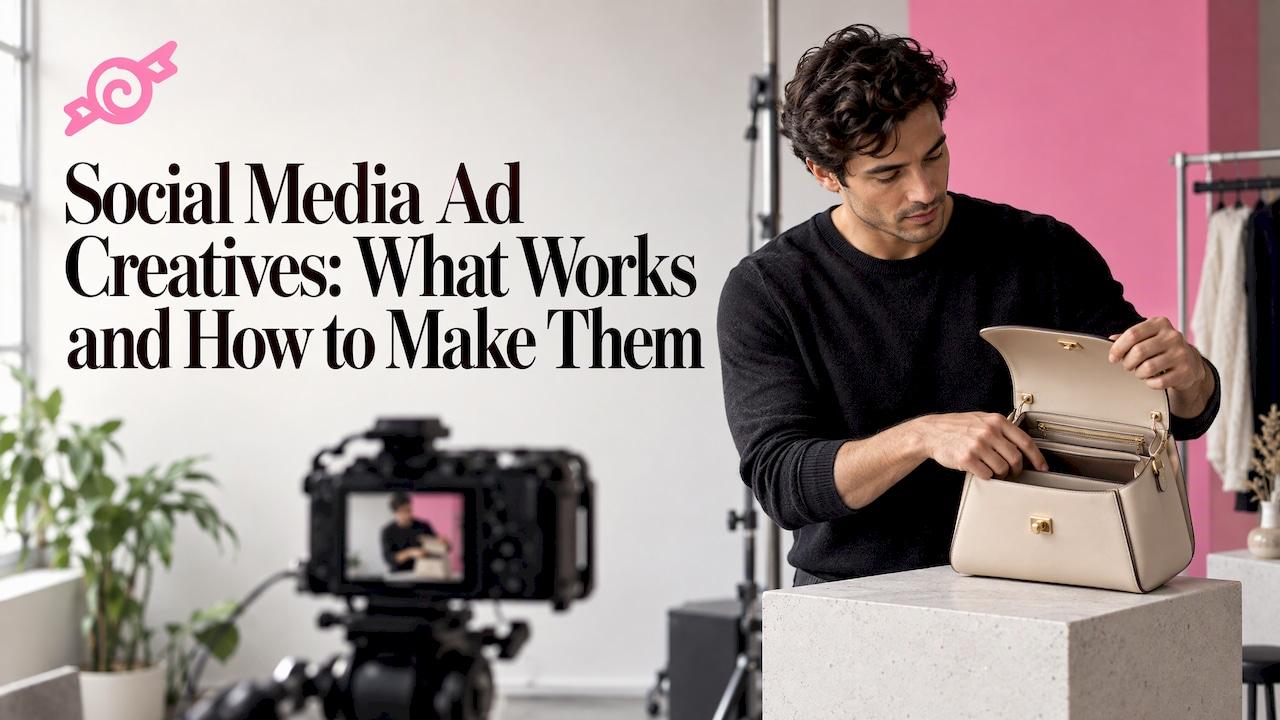
A social media ad creative is the image, video or carousel a person actually sees in the feed, and it does most of the work in your campaign. The research points the same way: creatives that open fast, show the brand early, and give people something to feel or learn beat ads that only look polished. The hard part is producing enough of them, in the right formats, without a studio, models and reshoots eating the budget. That is where AI production helps, and it is how we build ads at Blurcandy: product photography, model shoots, UGC-style ads and CGI films made with generative AI, with every frame checked by hand.
TL;DR
- Hook in the first one to two seconds, show the brand and message within five, and use one clear call to action.
- Match format to platform: vertical video for TikTok, Reels and Shorts, square or 4:5 for feeds, and statics where speed and price matter.
- Shorter ads (up to 10 seconds in one TikTok study) were seen in full more often.
- Test one variable at a time, and judge creatives on brand memory and conversions, not engagement rate alone.
- AI lets you make more variants without physical shoots; at Blurcandy, clients approve look frames before production begins.
Table of Contents
- What makes a social ad creative effective
- Choosing the format for each platform
- How to build the creative itself
- Making social ads with AI
- Testing creatives so you learn something
- A simple monthly creative routine
- Work with a studio built for this
- FAQ
- Sources
What makes a social ad creative effective
Start with the evidence, because opinions about "good creative" are cheap.
Ipsos analyzed roughly 1,800 video ads in its 2024 Social Misfits study. Ads that delivered creative and empathetic experiences were 20% more effective on sales outcomes. In social feed video, empathy (+47%) and new ideas (+31%) produced the strongest memory-encoding effects. In plain terms: people remember ads that make them feel something or show them something new, and memory is what turns into a purchase later.
System1's April 2025 short-form research adds a useful split:
- Showmanship features entertain: characters acting, a story unfolding, a tune people hum, spontaneous facial expressions.
- Salesmanship features inform: words on screen, direct address, fast cuts, facts and comparisons, product focus, a call to action.
Salesmanship features assume the viewer is already interested. Showmanship earns the interest first. A strong creative usually carries both, in that order.
The same research found that ads with exceptional early branding, meaning the brand is recognizable within the first two seconds, drove +88% memory lift, +92% brand awareness lift and +85% brand image lift compared with ads with weak early branding. Showing your logo or product early does not cost you attention.
The first five seconds
Meta and Toluna studied 100 ads across Germany, the UK, Italy and Turkey. Two findings matter for any brand:
- Hooks, meaning visual or audio cues that stop the scroll in the first one to two seconds, made ads 1.5x more likely to rank in the top 20% for purchase intent.
- Showing the brand and main message within the first five seconds made brand ads 1.7x more likely to rank there. Including a call to action, visually or in audio, made direct-response ads 1.9x more likely.
The practical rule: the opening frame needs a reason to stop, the brand needs to be visible almost immediately, and the ad needs to say what to do next.
Choosing the format for each platform

A creative that works on one platform often fails when pasted onto another. Search Engine Land's cross-platform guide describes the differences well: Meta suits storytelling, with polished feeds, quick Stories and casual, trend-driven Reels. TikTok favors authentic, lo-fi, creator-led content where engagement has to happen within the first second. Pinterest is a planning platform where high-quality vertical creatives with clear text overlays last a long time.
Here is a working map you can use when briefing a campaign:
| Placement | Typical format | What the creative needs |
|---|---|---|
| TikTok, Reels, Shorts | Vertical 9:16 video | Instant hook, native feel, captions |
| Facebook and Instagram feed | 4:5 or 1:1 image or video | Clear product, one message |
| Stories | Vertical, short | Fast pace, CTA near the end |
| Vertical image or video | Strong text overlay, aspirational look | |
| YouTube in-stream | 16:9 video | Brand in the first seconds, story arc |
Length matters too. EyeSee's 2024 study of 60 ads and 7,280 respondents in a simulated TikTok environment found that ads up to 10 seconds had a 71% higher chance of being seen in full, 15% higher brand recall and were 38% more liked than longer ads. That does not mean every ad should be 10 seconds, but it is a strong argument for a short cut of every concept.
Image, video or carousel?
Use video when the product needs motion or demonstration: a fabric moving, a serum texture, a bag opening. Use a carousel only when each card has a different job, such as problem, proof and offer. Use a static image when the buyer already knows the problem and wants price, speed or a direct path to purchase. Most brands need all three, which is why production cost per variant becomes the real constraint.
How to build the creative itself
A reliable structure for a single ad:
- Hook (0 to 2 seconds). A surprising visual, a question, a before and after, or a face reacting. The hook should relate to the product, not just grab attention.
- Message (2 to 5 seconds). Say what the product is and what it does for the viewer. Put the brand in frame.
- Proof or demonstration. Show the product in use. A close-up on physical goods, the screen for software, the result for beauty.
- One call to action. One. "Shop now" or "See the collection," visible on screen and, where it fits, in the voiceover.
- Native finish. Captions burned in, because many people scroll with the sound off, and key text kept away from the edges where platform interfaces cover it.
Keep each ad to one idea. Clutter is the most common reason a good product looks forgettable in a fast feed.
Product ads vs. model and UGC-style ads
Product-led creatives (clean packshots, 3D rotations, lifestyle scenes) work when the product is the draw: electronics, footwear, home decor, food and beverage. Model-led creatives work when the viewer needs to picture the product on a person: fashion, accessories, beauty. UGC-style ads work when you want the feel of a real recommendation, where the script and the natural delivery matter more than the camera.
The weak point in all three has traditionally been logistics: casting, location, styling, shipping samples, scheduling reshoots. Each new angle or audience variant meant another shoot.
Making social ads with AI
AI changes the production side, not the rules of good creative. Everything above still applies: a hook, early branding, one message, one CTA. What changes is how fast and how cheaply you can turn a proven idea into many versions: different models, backgrounds, languages, aspect ratios and cut lengths.
At Blurcandy, we produce AI ad films and commercials, AI model photoshoots, product photography, CGI and 3D product films, AI UGC ads and monthly social media content. The approach replaces physical models, sets and reshoots with generative AI workflows. Product photography typically turns around in 24 hours. We customize our generative models for each industry, and every frame is checked by hand for accuracy to your product and brief. That last point matters most for ads: a product that looks slightly wrong in an AI image is worse than no image at all.
Before anything is built, clients approve look frames. You see the direction (the lighting, the styling, the setting, the model) and sign off before production, which avoids the expensive discovery that a finished set of ads is off-brief.
You can see how this looks across categories on our work page and by industry, from fashion and beauty to footwear, food and beverage, and home decor. For brands with hardware or tech products, our 3D product animation page shows how CGI-style motion works in ads.
Where AI helps most in a creative program
- Variants of a winning idea. Same hook, different model, setting or language.
- Product catalogs. Consistent visuals across hundreds of SKUs, so ads and listings look like one brand.
- Seasonal refreshes. New backdrops and styling without a new shoot.
- Motion and 3D. Product films that would otherwise need a CGI team and weeks of rendering.
- UGC-style ads. Spokesperson and creator-style videos built around a strong script. Our guide to AI spokesperson videos covers how to make them well.
If you are deciding what to automate and what to produce with care, our piece on social media content automation lays out the split.
Keep the human judgment where it counts
The IAB and Lowenstein's June 2024 generative AI whitepaper notes that human judgment remains necessary for context, empathy and unconventional ideas. That is a good division of labor: people choose the angle, the message and the story; AI scales the execution. Deciding what your ad says is still your job and your strategist's job. Producing twenty good versions of it should not be.
One more practical point: platforms have their own rules on labeling AI-generated or heavily edited content in ads, and those rules change. Read the current ad policy of each platform you run on before launch, and keep a record of how each asset was made.
Testing creatives so you learn something
More variants only help if you can read the results.
Change one variable at a time. Test three to five hooks on the same body, then messages on the same hook, then formats of the same script. If you change everything, you will not know what worked.
Test rough concepts early. Listen Labs' creative testing guide points to four dimensions worth measuring: message clarity, emotional resonance, brand attribution and action intent. It also recommends testing with your actual target audience, and controlling for production quality when you compare assets, so a better-looking ad does not win just for looking expensive. Look frames are a natural place to do this: you can compare directions before full production.
Do not judge by engagement alone. A WPP Media and System1 creator effectiveness playbook covering 129.6 million engagements found no significant relationship between engagement rate and brand memory lift. A ad people like and tap can still be forgotten. Pair engagement with brand recall, click-through and conversion data.
Do not assume AI hooks are better or worse. In an 8-week test of 240 Instagram Reels ads in India and Indonesia, AI-only hooks had a median view-through rate of 44%, human hooks 41% and hybrid hooks 45%. Conversion rates were 2.9%, 3.1% and 3.2%. The lesson is that the idea and the hybrid of craft and speed matter more than the tool, and that view-through and conversion can tell different stories.

Refresh before fatigue. Rising frequency, falling click-through rate and climbing cost per result are the usual signs that an audience has seen enough. Google's guidance on repurposing social assets also advises making changes gradually and favoring quality over quantity so the ad system has time to measure.
A simple monthly creative routine
For a brand running paid social, this rhythm is enough to start:
- Week 1: Pick two or three angles based on last month's data and customer questions.
- Week 2: Approve look frames for each angle, then produce the hero version in vertical video plus a static.
- Week 3: Build variants: three to five hooks, short cut-downs, 4:5 and 1:1 exports.
- Week 4: Read results, keep what won, retire what tired, brief the next round.
Because AI production does not depend on booking models, sets and photographers, weeks 2 and 3 can compress. For product photography, our typical turnaround is 24 hours.
Work with a studio built for this
If you are an e-commerce brand, marketer or brand owner who needs a steady flow of product visuals, model imagery, UGC-style ads or CGI films for social, this is what we do. We have served over 200 brands with a client rating of 4.8/5, and projects are quoted by scope and deliverables, so you pay for the campaign, photoshoot, film or content package you actually need.

See our services to pick the format that fits your campaign, or start from the Blurcandy homepage to tell us about your product and brief. If you are planning a longer story for your brand, our guides to brand film production and commercial video production show how AI changes the process.
FAQ
How long should a social media ad creative be?
Short ads tend to be seen more fully. In EyeSee's TikTok study, ads up to 10 seconds had a 71% higher chance of being seen in full than longer ones. Build a short cut of every concept, then add longer versions where the story needs them.
Can AI-generated ads perform as well as traditional shoots?
Performance depends mostly on the idea, the hook and the message. In one Reels test, AI-only hooks matched or beat human hooks on view-through, while hybrid hooks led on conversion. Hand-checking every frame for product accuracy is what keeps AI visuals on brief.
What formats do I need for each platform?
Vertical 9:16 video for TikTok, Reels, Shorts and Stories, 4:5 or 1:1 for feeds, 16:9 for YouTube in-stream, and statics or carousels for quick messages. Producing one concept in all of them is far easier when you are not rebuilding a physical set for each.
How many creatives should I test at once?
Test one variable at a time: for example, three to five hooks on the same body. That way you know which change caused the result, and you can scale the winner into more formats.
Do I need to label AI-made ads?
Some platforms and regions require disclosure for AI-generated or significantly edited content. Rules change, so check each platform's current ad policy before launching and keep a record of how each asset was produced.
Sources
- Ipsos, Social Misfits (2024)
- System1, The Long and the Short (form) of It
- Meta and Toluna study on Reels purchase intent
- Search Engine Land, cross-platform ad creative
- Quirks, EyeSee TikTok creative study
- IAB and Lowenstein, generative AI whitepaper (June 2024)
- Listen Labs, The Complete Guide to Creative Testing
- WPP Media and System1, Creator Effectiveness Playbook
- Instagram Reels hook A/B test, Bharat Publication
- Google, turning social assets into YouTube ads