AI commercial production is the making of ads, from a 15-second spot to a product film, with generative AI models in place of cameras, sets, actors and reshoots. The brands getting the most from it treat it as a production discipline with a brief, approved looks, hand-checked frames and a finished file, not as a prompt typed into a tool. That is how we work at BlurCandy: you approve the look before we build, and every frame is checked by hand against your product and brief. Below you will find how the process runs, what drives time and cost, which rules to know, and how to brief it.
TL;DR
- AI commercial production replaces physical shoots with generative AI workflows, so there are no sets, models or reshoots to schedule.
- Adoption is mainstream: an IAB survey published in January 2026 found 83% of surveyed advertising executives' companies had deployed AI in the creative process.
- The strongest results come from a hybrid approach: AI generates, people direct, check and finish.
- Time and cost depend on scope, number of deliverables, product complexity and rounds of review. Our product photography is typically delivered within 24 hours.
- Know the disclosure and responsible-use rules for the markets where your ad will run, and keep human review in the process.
Table of Contents
- What AI commercial production actually is
- Are brands really making commercials with AI?
- How AI commercial production works, step by step
- What you can make
- What drives time, cost and quality
- Rules and checks before an AI ad goes live
- How we produce your commercial
- Where AI commercial production is heading
- FAQ
- Sources
What AI commercial production actually is
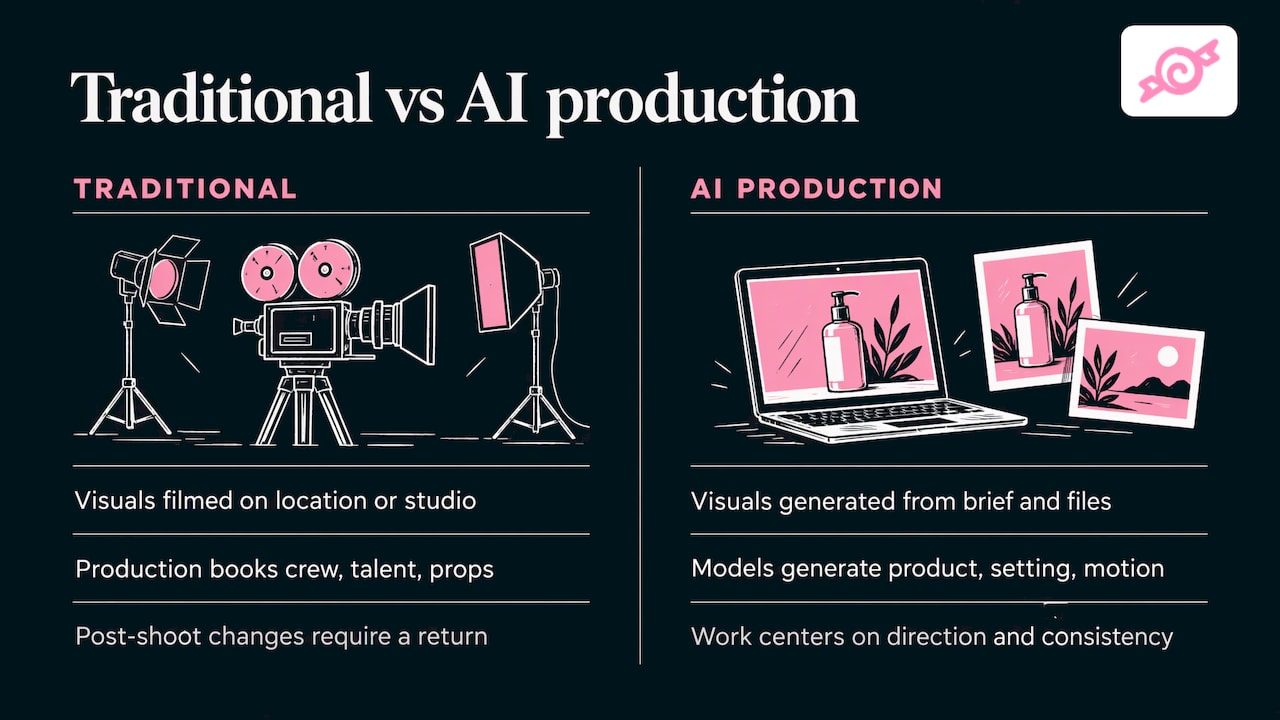
A traditional commercial needs a location or studio, lighting, a crew, talent, props, and a post-production team. Each of those is a booking, a cost and a schedule risk. If the client changes the product color or the script after the shoot, you pay to go back.
In AI commercial production, the visuals are created by generative models guided by a creative brief, reference images, your product files and a storyboard. The product, the setting, the model or spokesperson and the motion are generated rather than filmed. The output is the same kind of asset you would get from a shoot: a commercial, a model photoshoot, a product video, a CGI-style rotation, a UGC-style ad or a set of social posts.
What changes is where the effort sits. Instead of logistics, the work is in direction: defining the look, keeping the product accurate, keeping characters and styling consistent across shots, and finishing the edit. This is why a studio matters. Generating a pretty clip is easy. Generating forty shots of the same sneaker, with the same stitching and the same color, across three formats, is production work.
Are brands really making commercials with AI?
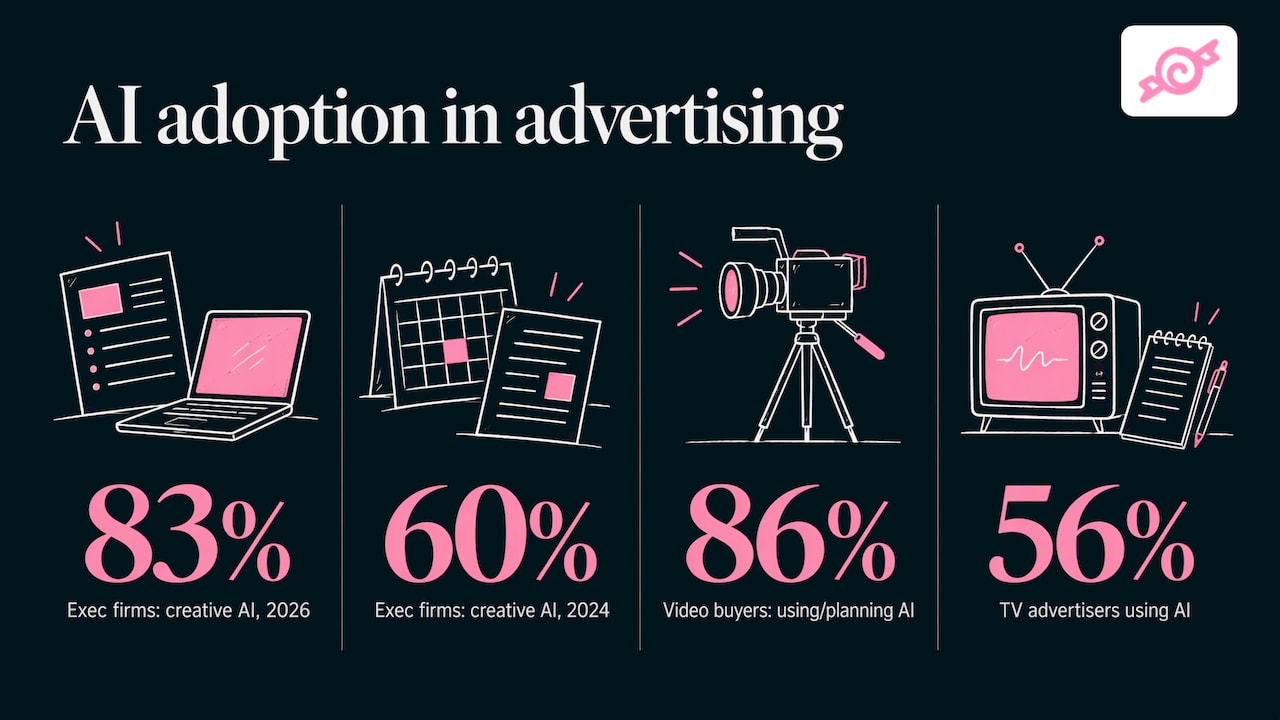
Yes, and in volume. The Interactive Advertising Bureau (IAB), the US digital advertising trade body, reported on January 15, 2026 that 83% of surveyed advertising executives' companies had deployed AI in the creative process, up from 60% in its 2024 study. The same survey found that 86% of digital-video buyers were using or planning to use generative AI to build video-ad creative, and 56% of surveyed advertisers used AI for TV ads.
A concrete example: cat litter brand Fresh Step made three 15-second commercials featuring talking cats with its agency RECE in 30 days, at one-tenth the cost of traditional production, according to Marketing Dive. The same account describes AI being used to prototype creative concepts and to depict the cats, and brand leaders said the ads were openly computer-generated rather than an attempt to pass as live action.
That example is useful because it shows where AI is strongest: concepts that would be expensive or impossible to film, produced fast enough to test and revise. A talking cat needs no trainer, no animal handler and no reshoot.
How AI commercial production works, step by step
Here is the routine, with the points where projects typically go wrong.
1. Brief and goal
Start with what the ad must do: launch a product, lift a category, fill a catalog, feed paid social. Write down the audience, the single message, the formats (vertical, square, widescreen), the length and where it will run. Most disappointing AI ads come from a vague brief, because the model fills the gaps with generic choices.
As a brand owner, you hand us the brief, product references and any brand guidelines. We build from there, and you do not need to arrange a studio, talent or a crew.
2. Concept and storyboard
A storyboard turns the idea into a shot list: what appears, in what order, with what motion. Where it goes wrong: skipping this and generating shots one by one, which produces a collection of clips instead of a story. The Canadian Marketing Association's AI video playbook recommends clear handoffs between AI generation and human post-production, and a storyboard is the first of those handoffs.
3. Look approval before production
This is the step that saves the most money. Before the full build, you see look frames: still images that show the lighting, color, setting, styling and product rendering. You approve them, or you redirect, and only then does production start. On a physical shoot, a change after wrapping means a reshoot. Here, the change happens while it is still cheap.
Where it goes wrong: approving looks without checking the product details that matter to your customer, such as logo placement, texture, proportions or the exact shade. Check those on the frames.
4. Generation with customized models
Generic tools drift. A bag changes its clasp between shots, or a bottle label gains extra letters. Our studio customizes generative AI models for each industry, so fashion, beauty, footwear, electronics and food work from setups tuned to how those products look and behave. That is a large part of keeping the output faithful to the product, which is what a shopper judges first.
5. Frame-by-frame review
AI output needs inspection. Hands, reflections, text on packaging, fabric folds and fine edges are where errors hide. We check every frame by hand against your product and brief. If you produce in-house, budget real time for this step: it is the difference between an ad that looks expensive and one that looks off without anyone being sure why.
6. Edit, sound and finishing
Shots become a commercial through pacing, transitions, music, voiceover, captions and color grading. The CMA playbook favors a hybrid model in which AI improves efficiency while human post-production supplies polish and control. We deliver ready-to-use visuals for marketing, product listings and brand storytelling, so the files you receive are meant to go straight into your ad platforms and store pages.
7. Versions and delivery
One approved look can produce many outputs: a 15-second cut, a 30-second cut, vertical versions for social, stills for listings. Plan the versions at the brief stage, since consistency across them is easier to keep when they come from the same approved look.
What you can make
AI production covers more than the TV-style spot. These are the formats brands commission most:
| Format | What it is | Best for |
|---|---|---|
| AI ad films and commercials | Scripted, directed spots built from generated scenes | Launches, brand campaigns, paid video |
| AI model photoshoots | Generated models wearing or holding your product | Fashion, accessories, catalogs |
| Product photography | Clean and styled images of the product | Product listings, e-commerce, ads |
| CGI and 3D product films | Rotations, reveals and technical animations | Electronics, home goods, premium products |
| AI UGC ads | Creator-style videos in the format social audiences expect | Paid social, testing hooks |
| Social media content | Recurring sets of posts and short videos | Always-on brand channels |
These are the six services on our services page, and you can see finished examples in the portfolio. If your category has particular visual needs, the industry pages show how we approach fashion, beauty, footwear, bags, electronics, home decor and food and beverage.
Two of these formats are worth a closer look. For spokesperson-led ads, our guide to AI spokesperson videos covers how to make them well. For paid social, social media ad creatives explains what tends to work and how to build it.
What drives time, cost and quality
There is no honest flat price for "an AI commercial", because scope decides it. We quote each project on its scope and deliverables, charging per campaign, photoshoot, ad film, video or content package. These are the factors that move the number and the schedule.
Length and number of shots. A 15-second spot with a handful of scenes is a different job from a 60-second film with a recurring character.
Product complexity. Reflective, transparent, textured or detailed products take more care to render accurately than a plain box. This is where industry-tuned models and hand-checking matter.
Characters and consistency. A model or spokesperson who must look identical across many shots, formats and weeks needs deliberate setup.
Number of versions. Aspect ratios, lengths, languages and product variants multiply the deliverables.
Review rounds. Approving look frames early keeps later changes small. Changes to the concept after production starts cost the most, as they do on a physical shoot.
Turnaround. Removing physical logistics is why AI production is fast. Our product photography is typically delivered within 24 hours. The Fresh Step campaign took 30 days from brief to three finished spots, which gives a sense of the timeline for a concept-led commercial with an agency in the loop.
On cost, the same Fresh Step reporting puts the saving at about one-tenth of traditional production for that campaign. Your own saving will depend on what you would otherwise have paid for: models, travel, studio hire, 3D artists, reshoots. Brands that currently spend on traditional CGI or model shoots tend to see the clearest difference, because those are the line items AI removes.
Rules and checks before an AI ad goes live
A responsible production process includes a review of what you publish, and where. Keep these checks in your workflow.
Disclosure
Rules on labeling AI-generated content are developing by market. In the European Union, Article 50 of the AI Act sets out marking duties for providers of systems that generate synthetic content and disclosure duties for deployers of deepfakes in image, audio or video. The European Commission's 2026 implementation guidance also notes that clearly artistic, creative, satirical or fictional works may use an appropriate disclosure that does not hamper enjoyment of the work. If you advertise in the EU, confirm with your legal adviser how Article 50 applies to your specific ad. For ads in other countries, ask your legal adviser or check the national advertising regulator's current rules, since they differ.
Responsible use
The IAB UK's Best Practice Guide for generative AI in advertising recommends risk assessment, designated accountability, human oversight, ongoing monitoring and disclosure proportionate to the risk of consumer harm. It also advises sizing the risk by possible harm to consumers and scaling human review accordingly. In practice that means a product ad that shows your real product accurately needs a lighter review than one that makes health claims or depicts real people.
A practical pre-launch checklist
- Product accuracy: shape, color, logo, label text and proportions match the real product.
- Claims: every statement in the script is one you can support, exactly as in a filmed ad.
- Likeness: no real person's face or voice is imitated without their written permission.
- Usage rights: your agreement states where and how long you may run the deliverables.
- Platform specs: formats, lengths and caption safe zones fit each channel.
- Consistency: the same product and styling appear across all cuts and stills.
- Disclosure: you have decided whether labeling is needed in each market and how it will appear.
On product accuracy and consistency, our hand-checked frames and approved looks are built to do this work for you.
How we produce your commercial
If you want a commercial, a model shoot, product images, a 3D product film, UGC-style ads or a monthly content set without arranging a physical shoot, this is what we do. We have served over 200 brands, with a client rating of 4.8/5, across categories from fashion to beauty. You approve the look frames before production begins, we customize generative AI models for your industry, and we check every frame by hand against your product and brief.

Browse the services to match your need to a format, or start from the BlurCandy home page to send us your brief. Pricing is a custom quote based on scope and deliverables, set out in a written proposal.
Where AI commercial production is heading
The IAB figures show a direction: AI has moved from experiment to routine in creative departments, and digital video and TV are the next areas of growth. Expect three things. Briefs will arrive with AI in mind, so the studio's role in directing and finishing becomes more valuable. Disclosure expectations will become more specific by market, so build labeling decisions into the plan. And brands will want volume, with more versions, more tests and more regular content, which is where a consistent approved look pays off. For ongoing channels, our piece on social media content automation covers what to automate and what to produce with care.
For a wider view of the category, see how commercial video production is defined and how AI changes it.
FAQ
Can you make a commercial with AI?
Yes. Generative AI models can create the scenes, products, models and motion for a commercial, and a production team then edits, sounds and finishes it. At BlurCandy, you approve look frames first, then we build and hand-check the footage and deliver files ready for your channels.
Are brands making commercials with AI now?
Yes. The IAB's January 2026 survey found that 83% of surveyed advertising executives' companies had deployed AI in the creative process, and 56% of surveyed advertisers used AI for TV ads. Fresh Step's talking-cat spots are one reported example.
How long does AI commercial production take?
It depends on length, number of shots and versions, and review rounds. Our product photography is typically delivered within 24 hours. A commercial takes longer, and the fastest route is a clear brief and early approval of the look frames.
Do I have to disclose that an ad was made with AI?
It depends on the market and the content. In the EU, Article 50 of the AI Act sets disclosure duties for AI-generated deepfakes, with an adjusted approach for clearly creative or fictional work. Ask your legal adviser how the rules apply to your ad and where it will run.
How much does an AI commercial cost?
We quote per project based on scope and deliverables, so the price reflects your length, formats and number of versions. For a reference point on savings, one reported campaign came in at about one-tenth of the cost of traditional production.
Sources
- IAB: The AI Ad Gap Widens
- Marketing Dive: How Fresh Step used AI to go from brief to ads at one-tenth the cost
- CMA: AI Video Generation playbook
- IAB UK: Best Practice Guide for the Responsible Use of Generative AI in Advertising
- European Commission: Implementation Guidance for the EU AI Act