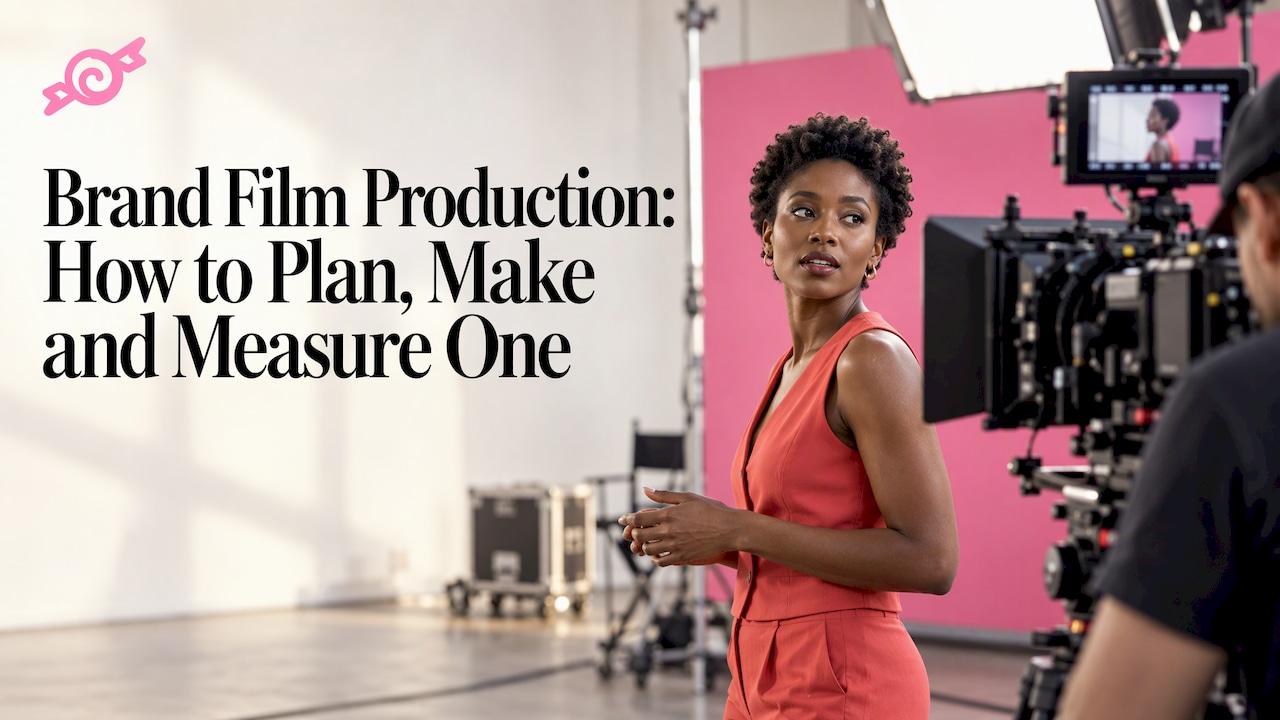
Brand film production is the work of turning what your company stands for into a story people choose to watch: concept, script, visuals, edit and distribution. The best results come from treating the film as the source of a whole content system, not a single video. That is the thinking behind how we build brand films at Blurcandy: AI-driven production of ad films and commercials with no physical sets or models, and with look frames you approve before production begins. This guide covers what a brand film is, what it can do for a business, the production steps, and what to check when AI is part of the process.
TL;DR
- A brand film sells a point of view and an emotion, not a product. It is judged on recall and preference over months, not on same-day clicks.
- Plan the film as a family: one master film plus shorter cuts for mid-funnel and retargeting, with the edit points mapped before production starts.
- Brand story first, product second. Research on award-winning branded films points to characters, challenge and values as the engine.
- AI production can replace sets, models and reshoots. Approve look frames early, and label synthetic performers where the law requires it.
- We produce AI ad films and commercials for brands, and you can see examples on our work page.
Table of Contents
- What a brand film is, and how it differs from other brand video
- What a brand film can do for your business
- Step 1: Find the single feeling and the story
- Step 2: Plan the film family before you shoot
- Step 3: Lock the look before you build
- Step 4: Produce, edit and score
- Step 5: Distribute and measure
- Making AI-built brand films safely
- Where Blurcandy fits
- FAQ
- Sources
What a brand film is, and how it differs from other brand video
A brand film is a longer, story-led video that represents a brand's values rather than selling a specific item. Academic work from the University of Leeds defines brand films along four lines: they sit apart from traditional advertising norms, use storytelling to express the brand's core value, take a cultural stance that invites viewers to agree or disagree, and aim to create an emotional experience.
That answers a common mix-up between "brand film" and "brand video." Brand video is the broad category: anything on screen that carries your brand. A brand film is the flagship piece within it. Around it sit other formats:
| Format | Job | Typical length | Judged on |
|---|---|---|---|
| Brand film | Build emotion and meaning around the brand | 60 to 120 seconds for a master film, longer for a story piece | Recall, association, preference |
| Consideration cut | Keep interest alive on social feeds | 20 to 45 seconds | Engagement, view-through |
| Conversion asset | Prompt a purchase or sign-up | 6 to 15 seconds | Clicks, sales |
The lengths come from a three-tier brand film structure described by D2C Times, where the master film feeds YouTube pre-roll, organic social and PR, and the shorter cuts feed Meta, TikTok and retargeting.
If you want a broader view of how commercial work is scoped, our guide to commercial video production and how AI changes it covers the neighboring territory.
What a brand film can do for your business
A brand film earns its keep through brand equity, not instant conversion. The clearest public evidence comes from a MAGNA study of the USPS Dear Santa franchise, reported by Forbes in December 2024. Viewers who watched the full 89-minute film were 19 points more likely to pick USPS as their first-choice holiday shipper. The same viewers rated the brand 30 points higher on "does social good," and 57% said they would tell others about it. A 30-minute episode lifted first-choice preference by 10 points and the trailer by 5, so more exposure to the story meant more lift.

That is a large entertainment production, and most brands will not make an 89-minute film. The lesson that scales down is the mechanism: audiences can feel the difference when content sets out to engage rather than to promote, and a story-led asset stays useful for longer than a social post that disappears in days.
There is also a measurement point worth knowing before you commission anything. According to D2C Times, in sequential exposure testing, audiences shown the master film first, then the consideration and conversion cuts, outperformed audiences shown only direct-response ads on 90-day lifetime value and average order value. They did trail on short-term return on ad spend. So judge a brand film over a quarter, not over a weekend.
Beyond paid media, one film works across your website, email, sales conversations and internal use such as hiring and onboarding. Plan for those uses at the start, because they shape the length and the cuts you ask for.
Step 1: Find the single feeling and the story
Every strong brand film starts with one emotional idea, not a feature list. Jones Road Beauty's creative director Cody Plofker told D2C Times that each film starts with a mood board session that defines a single emotional state before product or copy comes up. His test: if the team cannot feel it in three images, there is no film to build around it.
To get there, answer four questions in writing before any storyboard:
- What does the brand believe that a competitor would not say? This is the stance viewers can agree or disagree with.
- Who is the viewer, and what are they trying to become or escape? The protagonist should reflect their experience.
- What is the challenge in the story? A peer-reviewed study in Frontiers in Communication, covering Cannes Lions 2023 award-winning short films, found that emotion comes from characters who face and overcome challenges, with the brand integrated subtly into the narrative.
- What single thing should viewers remember? One idea, said clearly, in the brand's own tone.
A clear brand foundation makes this far easier. If your positioning is still loose, this piece on why a service business brand matters is a good place to tighten it before you brief a film.
The Leeds thesis adds a craft note: brand films connect through techniques borrowed from independent cinema, such as long shots, close-ups and a focus on character and emotion, so the message arrives through a story consistent with the brand's values rather than through emphasis on the product.
Step 2: Plan the film family before you shoot
The most expensive mistake in brand film production is shooting one film and then trying to carve ads out of it afterward. Map the cuts first.
D2C Times describes planning edit points on the storyboard at 15, 30 and 45 seconds, plus dedicated blocks of shots designed to be pulled out as still frames for static ads. In practice that means your brief should list:
- The master film (60 to 120 seconds) for your homepage, YouTube and PR.
- Two or three consideration cuts (20 to 45 seconds) with different openings for social.
- A set of 6 to 15 second conversion clips for retargeting.
- Stills for product pages and paid social, planned as shots rather than screenshots.
- Aspect ratios: vertical, square and horizontal, composed on purpose.
This is also where budget gets decided. Traditional production prices every one of those cuts in crew days, talent, locations and edit time. When the visuals are built with generative AI instead, those variants come out of the same approved look, which is why we plan the family up front. Our services page lists what we produce, from ad films and commercials to model photoshoots, CGI product films, AI UGC ads and monthly social content.
Step 3: Lock the look before you build
A brand film lives or dies on visual consistency: the same product colors, the same world, the same light from the first frame to the last. In a conventional shoot, you discover problems on set or in the edit. With AI production, the sensible place to catch them is earlier.
At Blurcandy, clients approve look frames before production starts, so the world, the product rendering and the mood are agreed before the film is built. Our approach customizes generative AI models for each industry, and every frame is checked by hand for accuracy to your product and brief. If you are in a category with specific visual demands, our industry pages show how that plays out for fashion, beauty, footwear, food and beverage, electronics and home decor.
What to approve at this stage:
- Product accuracy: logo, color, materials, proportions and details that customers will compare with the real item.
- Character and casting: age, look and feel of any people in the film, and whether they represent your audience.
- Environment and palette: the world the story happens in.
- Tone: the first three images should already carry the feeling from Step 1.
Step 4: Produce, edit and score
Once the look is approved, production is the assembly of shots into the story: visuals, motion, sound design, music, voice-over if any, and the edit. Keep these rules in mind:
- Lead with feeling. The first seconds should create the emotion, not introduce the company.
- Say one thing. If the film tries to cover your whole product range, viewers keep none of it.
- Keep the product in the background of the story. Research on branded entertainment points to values and entertainment over direct promotion.
- Cut for silence. Many viewers watch muted on social, so the film needs to make sense with captions or visuals alone, and still reward sound.
The Frontiers study also notes that creative development tends to require larger budgets and close collaboration between marketing, writers and a story editor. That is useful when you size the project: the story work is the investment, and the rest of production should serve it. Because AI removes physical sets, models and reshoots from the equation, more of the budget can go toward the idea and the polish.
Step 5: Distribute and measure
Publish the master film where people expect brand storytelling: your homepage, about page, YouTube, and PR outreach. Put the consideration cuts into mid-funnel social, and run the short conversion assets to people who have already seen the longer story. Reuse the same footage in sales decks, recruiting pages and trade show loops.
Measure at two speeds:
- Fast signals: view-through rate, completion, shares and saves, branded search lift.
- Slow signals: recall, association and preference in brand-lift surveys, plus 90-day customer value and average order value for audiences who saw the film versus those who saw only direct-response ads.
Do not judge the master film on last-click return. The research above shows why: the film's effect shows up in lifetime value and preference, while short-term return can look weaker.
Making AI-built brand films safely
AI production is a practical way to get cinematic visuals without a physical shoot, and a few checks keep a campaign clean.
Disclose synthetic performers where required. New York State law, in force from June 2026, requires any advertisement that includes a synthetic performer, even a completely invented AI person, to disclose it clearly and conspicuously. RicherNews reports penalties of $1,000 for a first violation and $5,000 for each one after. If you advertise in New York, build the disclosure into the film's design from the start, and check the rules in each state where the film will run.
Watch international labeling rules. For audiences in Europe, law firm Bird & Bird reports that draft EU guidance recommends labels on AI-generated and deepfake content from first exposure: prominent throughout short videos, an audible disclaimer at the start of audio ads under 30 seconds, and labels at intervals in longer videos, with human oversight. The guidance is a draft, so confirm the current text before a launch in the EU.
Check every frame against the product. A film can be beautiful and still show the wrong stitching, label or color. Our process includes a manual check of every frame against your product and brief, and your approval of look frames comes first.
Confirm rights in your agreement. Get usage rights for the finished film, music and any voice in writing before launch.
For legal questions specific to your campaign, such as claims, endorsements or disclosure wording, ask your own attorney.

Where Blurcandy fits
We are an AI creative studio producing ad films, commercials, model photoshoots, product photography, CGI product films, AI UGC ads and social content for brands. We have served over 200 brands and hold a 4.8/5 client rating. Product photography is typically delivered within 24 hours. The AI approach replaces physical models, sets and reshoots, so a brand film can come together with fewer moving parts and the look agreed before building.
Projects are quoted on scope and deliverables, whether that is one film or a family of cuts, stills and social content.

To see the style and finish, browse our portfolio, then tell us about your film on blurcandy.com. If you also need product visuals for your listings and ads, our guide to commercial product photography shows how that work fits around a film.
FAQ
What is the difference between brand film production and brand video production?
Brand video production is the wider term for any video that carries your brand. Brand film production usually means the flagship, story-led piece that expresses what the brand stands for. Most brands then produce shorter ads and social cuts from the same world.
How long should a brand film be?
A master film for web, YouTube and PR commonly runs 60 to 120 seconds, according to the D2C Times framework. Consideration cuts of 20 to 45 seconds and conversion clips of 6 to 15 seconds can follow. Longer formats work when the story earns them, as the USPS Dear Santa study showed.
How do I know if a brand film worked?
Look beyond immediate sales. Track recall, association and preference through brand-lift measurement, and compare 90-day customer value and average order value between audiences who saw the film and those who saw only direct-response ads.
Do I have to disclose AI in a brand film?
In some places, yes. New York State requires clear and conspicuous disclosure of synthetic performers in advertisements as of June 2026, and EU draft guidance recommends labeling AI-generated content. Check the rules where your film will run and plan the disclosure into the edit.
Can brand films be made without a physical shoot?
Yes. Generative AI workflows can build the visuals without sets, models or reshoots, with look frames approved before production. We produce AI ad films and commercials this way for brands across fashion, beauty, footwear, food, electronics and home.
Sources
- The Affective Power of Brand Films, University of Leeds thesis
- Why Long-Form Entertainment Can Be A Content Marketer's Biggest Gift, Forbes
- Crafting branded entertainment, Frontiers in Communication
- The Fine Print Behind Your Cheap AI Video, RicherNews
- When Marketing Meets GenAI: The IP Questions You Can't Ignore, Bird & Bird